Clinician reviewing medical imaging in a health screening setting
CONFIDENTIAL CASE STUDY
PANCREASaver® · HEALTH SCREENING

How a High-End Health Screening Center Built a Scalable AI-Enabled Pancreatic Cancer Screening Program

A high-end health screening center in Taiwan integrated PANCREASaver® into its contrast-enhanced abdominal CT workflow—creating a differentiated premium screening program with measurable patient adoption and incremental revenue.

25/dayCurrent average
PANCREASaver® cases
650/monthCurrent average
monthly cases
2023TFDA license
issued
Prepared for clinical and health-system audiences · September 2026
Customer identity withheld at the center’s request

Making better use of the abdominal CT pathway

Taiwan’s National Health Insurance system provides a large population-based healthcare environment in which medical imaging is widely used. That creates both a clinical opportunity and an operational challenge: how can existing abdominal CT examinations deliver more actionable value?

2.59MTotal CT examinations in Taiwan in 2022, based on an analysis of National Health Insurance claims data.[1]
~900KEstimated annual abdominal CT examinations, based on the center team’s internal claims-data analysis.[2]
2,659Pancreatic cancer deaths reported in Taiwan in 2021 by the Taiwan Cancer Registry.[3]

Pancreatic cancer remains a high-mortality disease in Taiwan

The Taiwan Cancer Registry reported a crude pancreatic cancer mortality rate of 11.38 per 100,000 people and an age-adjusted mortality rate of 5.94 per 100,000 in 2021. Pancreatic cancer ranked seventh among cancer mortality causes in the published table.[3]

A rising disease burden

A nationwide study of Taiwan’s cancer registry and cause-of-death data found that age-standardized pancreatic cancer incidence increased from 3.7 per 100,000 in 1999 to 5.0 per 100,000 in 2012. Mortality increased from 3.5 to 4.1 per 100,000 during the same period.[4]

Why CT workflow matters

The opportunity is not necessarily to add another examination. It is to provide an additional AI-assisted review layer for imaging that is already part of a patient’s health examination.

Creating a differentiated screening experience without disrupting workflow

The center wanted to offer

  • Advanced imaging and AI-assisted analysis
  • More personalized health information
  • Earlier awareness of potential pancreatic findings
  • A premium service with clear patient value
  • No additional CT appointment
  • No replacement of radiologist review

The patient pathway

01Health examinationPatient selects the AI-enabled examination package.
02Contrast-enhanced CTExisting abdominal CT examination is performed.
03AI analysisPANCREASaver® analyzes the CT images automatically.
04Radiologist reviewSuspicious findings are reviewed and confirmed by a qualified professional.
05Follow-up discussionFindings are incorporated into the examination communication.

The clinical role of PANCREASaver®

PANCREASaver® is an AI-assisted computer-aided detection tool for contrast-enhanced abdominal CT. It supports radiologist review; it does not replace radiologist judgment or independently establish a diagnosis.

From a five-patient pilot to approximately 25 cases per day

A measured rollout

Month one · 5 patients

Focused pilot to validate patient interest, staff communication, image review and report integration.

Month two · 10 patients

Utilization doubled as the center refined how it presented the AI-enabled examination.

Current · ~25 cases per day

The program now averages approximately 25 PANCREASaver® cases per day, or about 650 cases per month.

Current utilization

25

Approximately 25 PANCREASaver® cases per day
Current average daily utilization

650

Approximately 650 cases per month
Approximately 25 PANCREASaver® cases per day

Incremental package value

US$631Approximate incremental revenue per patient
NT$20,000 / patient
US$410KEstimated monthly incremental revenue
650 cases × US$631
US$985KApproximate total monthly center revenue
Broader center operation, inclusive of AI-enabled offerings

How AI created additional marginal value

The center used PANCREASaver® to create an AI-enabled premium examination option around existing CT imaging. The resulting value came from a combination of patient adoption, differentiated service design and incremental package revenue—not from attributing the center’s total revenue to PANCREASaver® alone.

A clinical proposition supported by published evidence

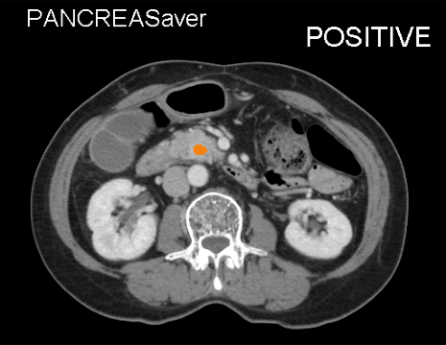
PANCREASaver CT output

Illustrative view of the same CT examination with PANCREASaver® output. AI findings require qualified clinical review.

Published performance

92.1%

Sensitivity for tumors under 2 cm in the cited The Lancet Digital Health study setting.[8]

AUC 0.95

Nationwide real-world validation across 1,473 CT studies in Radiology.[7]

Taiwan regulatory status

TFDA logo
TFDA License No. 衛部醫器製字第007946號
Issued in 2023; publicly listed as valid through July 13, 2028.[9]

U.S. status

FDA Breakthrough Device Designation
510(k) submitted July 2026 and under FDA review. PANCREASaver® is not yet cleared for U.S. marketing.

“This deep learning–based tool had very good accuracy, and sensitivity approaching that of subspecialist radiologists… Tools such as this promise to benefit routine workflow and patient care.”— Aisen & Rodrigues, Radiology editorial, 2023

A repeatable model for AI-enabled health screening

The playbook

1

Start with a focused pilot.

2

Integrate AI into the existing CT workflow.

3

Refine staff and patient communication.

4

Measure adoption and scale with demand.

Conclusion

This case shows how a high-end health screening center can use AI not only to support imaging review, but also to create a differentiated service model around examinations already being performed.

References

[1] Taiwan National Health Insurance CT utilization analysis, reported by UDN Health: https://health.udn.com/health/story/5959/7331843
[2] Internal analysis of Taiwan National Health Insurance claims data. The abdominal CT estimate requires publication of the claims period, procedure-code definition and calculation method.
[3] Taiwan Cancer Registry. Incidence and mortality rates for the top 10 cancer in Taiwan, 2021. Official PDF
[4] Tseng CM et al. Incidence and mortality of pancreatic cancer on a rapid rise in Taiwan, 1999–2012. Cancer Epidemiology. 2017;49:75–84. DOI
[5] Chang JS et al. The incidence and survival of pancreatic cancer by histology… from Taiwan. Cancer Medicine. 2018;7:5775–5788. PMC
[6] Su YY et al. Systemic treatments in pancreatic cancer: Taiwan pancreas society recommendation. Biomedical Journal. 2024;47(3):100696. DOI
[7] Chen PT et al. Pancreatic Cancer Detection on CT Scans with Deep Learning. Radiology. 2023. PMID 36098642
[8] Liu KL et al. Deep learning to distinguish pancreatic cancer tissue… The Lancet Digital Health. 2020. PMID 33328124
[9] Taiwan FDA AI/ML medical-device listing and public license record: TFDA listing · license record
Disclaimer: This case study is anonymized at the customer’s request. Patient volumes and financial figures are based on information provided by the participating center. PANCREASaver® is an AI-assisted decision-support tool for qualified healthcare professionals and does not replace radiologist judgment or independently establish a diagnosis. Currency conversions are approximate. Regulatory status and availability vary by country.